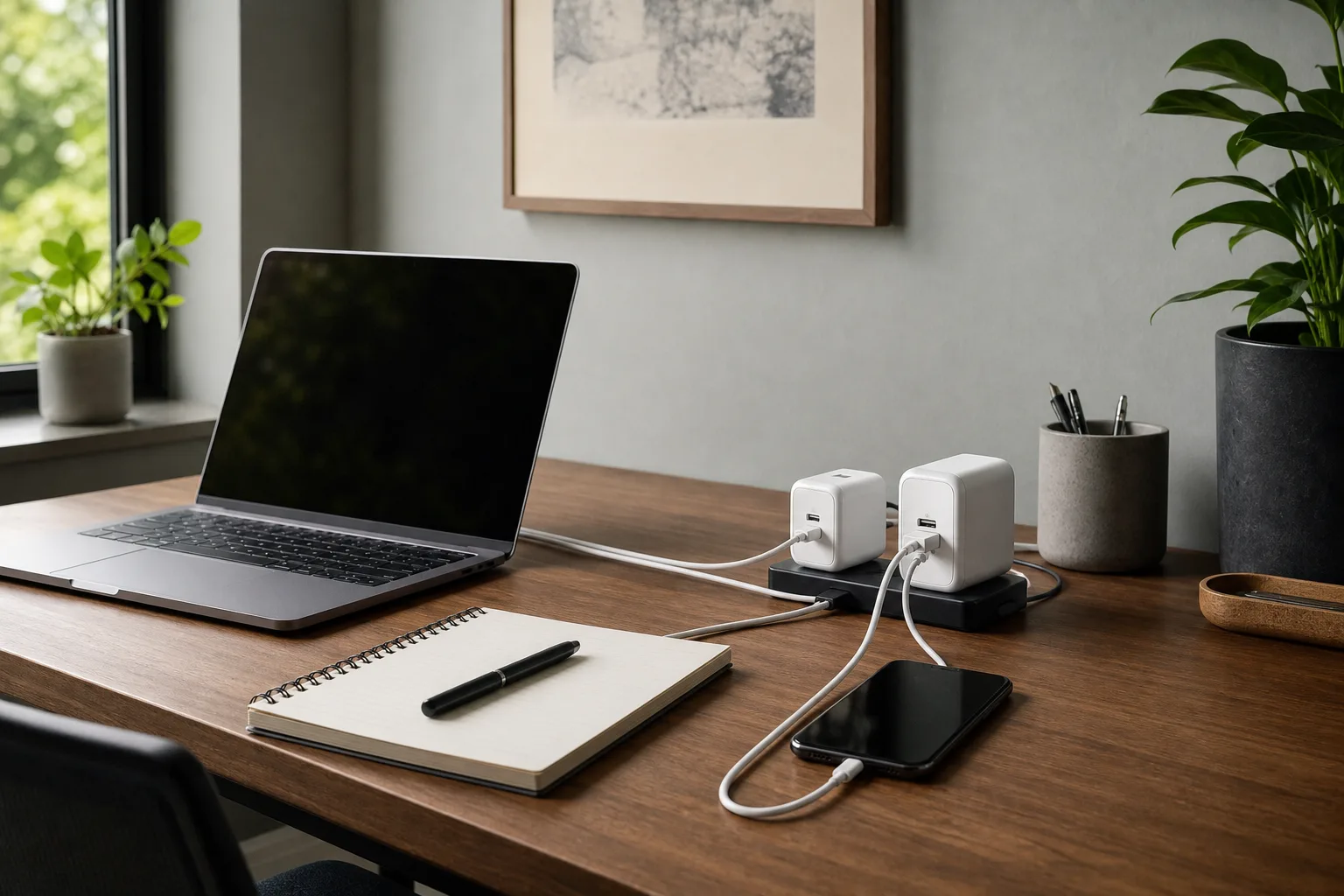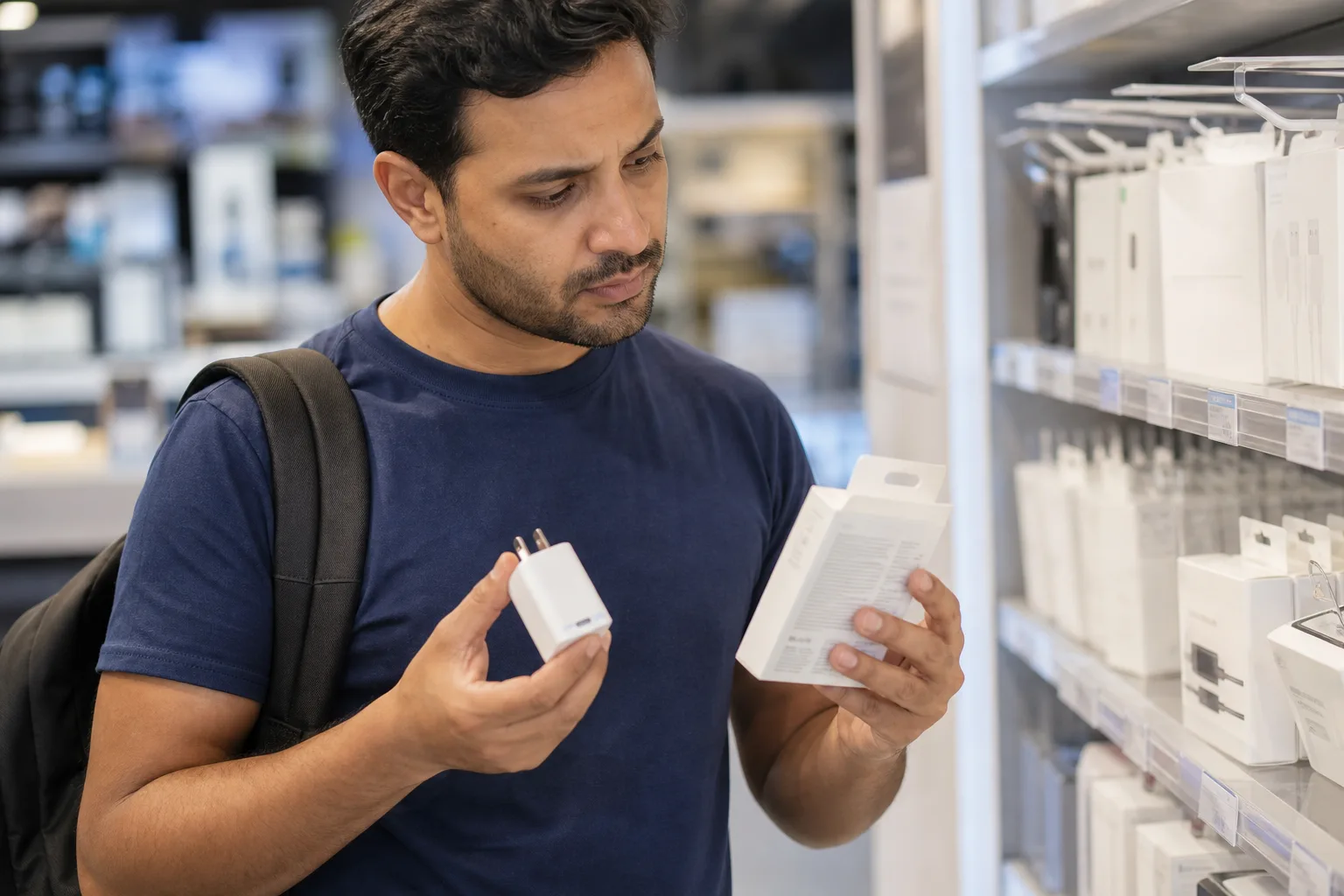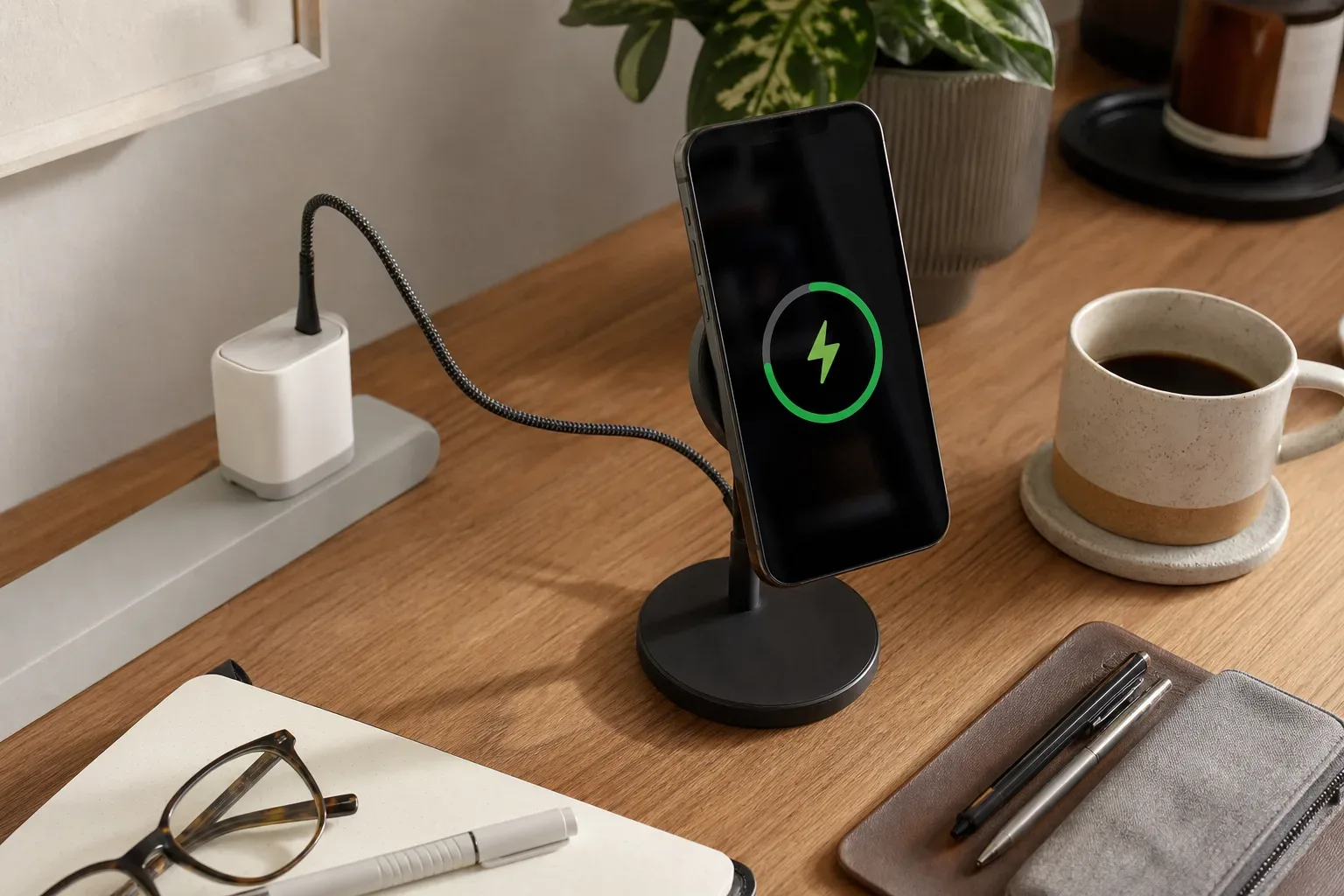
Choose a travel charger for the devices that will charge together. A 35W adapter with two sockets is not two independent 35W chargers. Its shared output can matter more than its folded size when you arrive with both a phone and a tablet nearly empty.
One documented example of shared output
Apple publishes the following allocation for its 35W Dual USB-C Port Power Adapter. These are the manufacturer's output limits for the stated combinations, not our measurements or guaranteed power continuously drawn by each device.
| Connected devices | Published allocation | Planning implication |
|---|---|---|
| Mac laptop plus iPhone or iPad | Up to 17.5W for each device | Check whether the laptop's requirements fit this shared limit before relying on it for work. |
| iPhone plus iPad | Up to 17.5W for each device | Do not budget 35W per port for a short charging stop. |
| Mac laptop or iPhone plus Apple Watch or AirPods | Up to 27.5W for the larger device and 7.5W for the smaller one | Allocation depends on the combination, so counting ports alone is insufficient. |
This example is useful even if you buy another brand: find its equivalent diagram for the exact ports you will occupy. If a manufacturer lists single-port maxima but no simultaneous-use behavior, shared output remains unknown. Do not fill that gap by dividing the headline number yourself.
Set the target using your exact phone
Apple's fast-charge guidance distinguishes model generations. It specifies a 40W-or-higher adapter for the iPhone 17, 17 Pro and 17 Pro Max claim of roughly 50% in 20 minutes, and 20W or higher for the iPhone Air and 17e claim of roughly 50% in 30 minutes. These are Apple's stated conditions; settings, use and temperature affect results.
Consequently, the 35W dual-port example above is not a match for the 40W adapter condition, even before sharing power. It may still charge a compatible phone; the distinction is whether it meets the particular fast-charge target you are buying for. For another phone or a laptop, read that device maker's requirements instead of applying iPhone numbers.
Make a two-device packing plan
| Situation | Record | Decision |
|---|---|---|
| One phone, overnight | Phone model, charger protocol, cable ends and bedside reach | One compatible port may cover the task; no extra ports are required just for the overnight scenario. |
| Phone and tablet during a short stop | Each device's desired charging rate and the adapter's two-port allocation | Select shared outputs that meet the goal, or charge the priority device alone. |
| Phone and working laptop | Laptop recommended adapter power and the exact laptop-port allocation with the phone attached | Do not assume a battery percentage indicator means the charger can sustain the laptop workload. |
Check the wall side and the cable side
Compare the charger with prongs extended and cables connected. A folded-body measurement excludes the clearance you need behind furniture. Check that it will sit securely without blocking the neighboring socket or bending a plug against a wall.
For international travel, match the adapter's printed input range and frequency to the destination supply, then check plug shape. A plug-shape adapter does not by itself convert voltage. If the label or destination requirements are unclear, resolve that before travel rather than treating a universal-looking plug as proof.
On the USB side, use the cable power and data guide. The charger and cable are separate capabilities; neither overrides the device's charging limits.
Rehearse the actual setup
- Connect all devices and the exact cables you intend to pack.
- Check each charging indicator, then connect and disconnect the second device to observe whether the arrangement resumes correctly.
- Confirm reach to the resting device without pulling on the outlet.
- Keep the manufacturer's instructions with the model record. A charging icon proves basic function, not the advertised wattage or electrical certification.
If your trip includes a battery pack, plan when that pack recharges too. Our magnetic battery guide separates input, wired output and wireless output so they do not all get counted as the same power requirement.
Research-based guidance. Read our sources, testing and illustration policy.