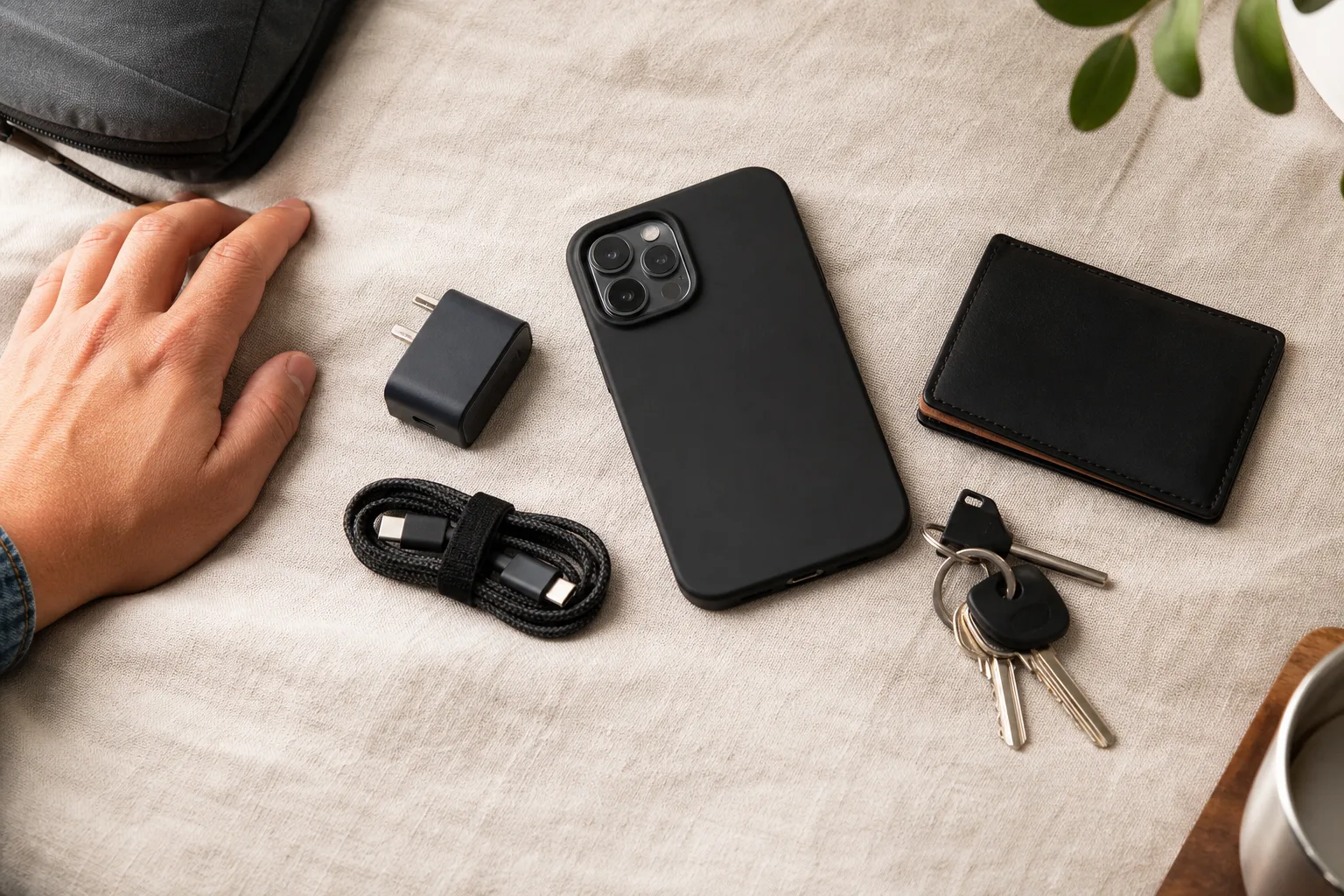
Begin with what you carried yesterday. Put the phone, case, wallet, cable, charger, bank and any mounts on a table. For each accessory, name the last time you used it away from home. The aim here is to decide what earns a place in the daily kit before choosing a pouch.
Choose a base kit around your routine
A fitted case and a reliable charging route cover many routines. If you have power at your desk, a cable may be enough for the workday. If you regularly finish the day with low battery and no outlet, add a bank sized for that shortfall. Do not add a bank solely because every travel checklist includes one.
Write down the problem before the product: “I need power on the train home” is more useful than “I need a new battery pack.” Record what you already use to solve it. Two accessories that cover the same need may still be justified, but give the spare a reason to travel with you.
Use this carry decision sheet
Copy this blank worksheet into your notes and fill it in during an ordinary week. It is a reader exercise, not a record of products we tested. Repeat the last row for each extra item.
| Item or function | Your observation | Your decision |
|---|---|---|
| Phone case | Fit or handling issue to solve: ____ | Keep / replace / investigate: ____ |
| Cable and charging source | Where used and what was missing: ____ | Carry daily / leave at destination: ____ |
| Power bank | When an outlet was unavailable: ____ | Carry daily / reserve for specific days: ____ |
| Extra wallet, grip or stand | Last use and duplicated function: ____ | Keep / remove / try without it: ____ |
Avoid stacked accessories
A wallet, ring, stand and magnetic pack may compete for the same space on the phone. List which combinations work together without removal. A separate wallet can sometimes make the phone setup simpler than repeatedly detaching a combined accessory. If a repeated swap annoys you, record the task it interrupts before buying another attachment.
Review the week, then pack
Separate the notes into missing functions, items used regularly and items never used. Remove an unused duplicate first. Keep an occasional item in a separate kit when you can identify the days that need it. An essential backup may deserve space even if unused; write down the failure it covers rather than applying an automatic “unused means remove” rule.
Once the list is settled, use the small-pouch layout worksheet to check physical fit and access. If you are planning a trip with several devices, use the travel connection worksheet to map those extra connections separately. A travel exception does not have to become permanent daily luggage.
Research-based guidance. Read our sources, testing and illustration policy.