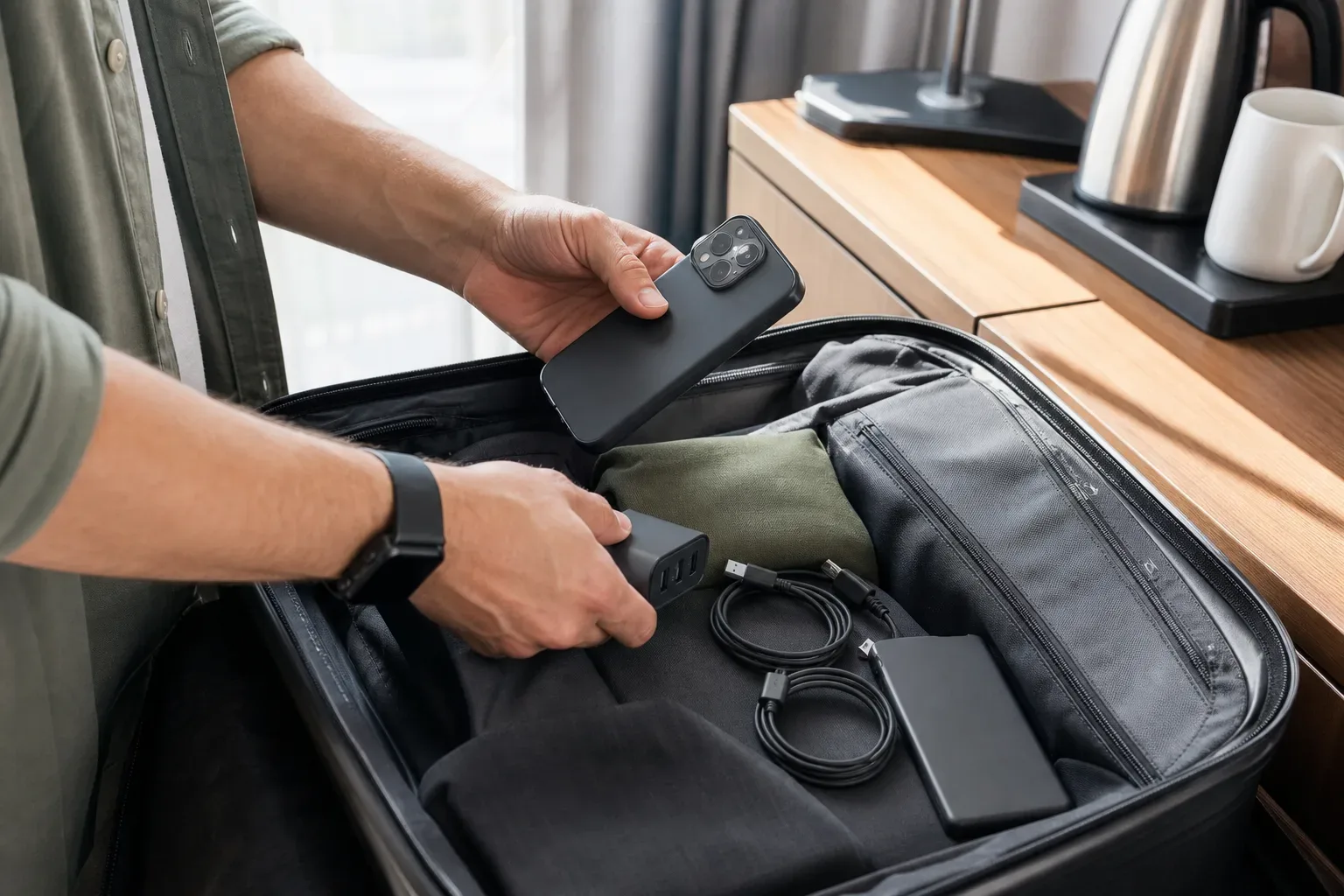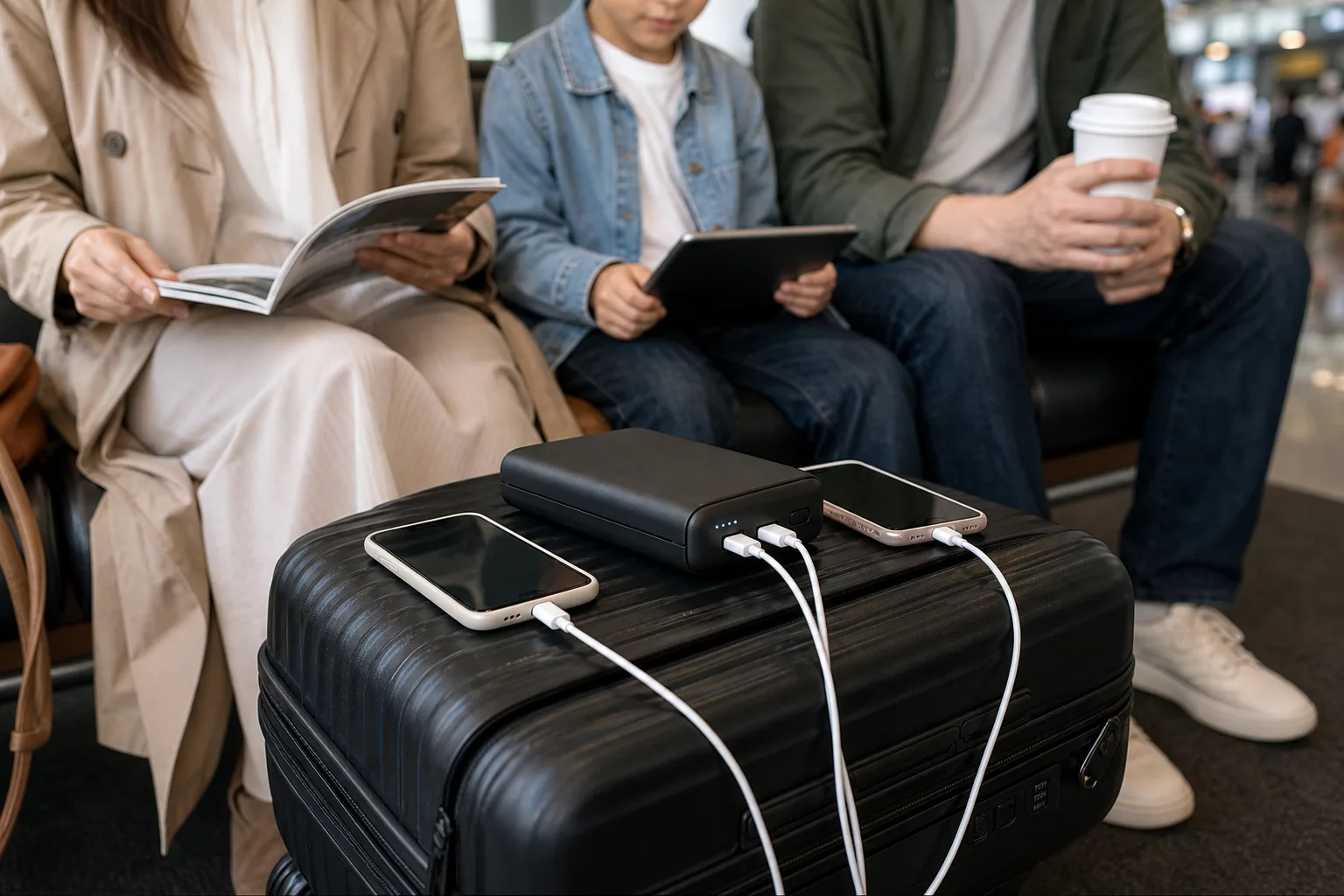
A family charging plan starts with who carries each battery. Put each person's intended phone cable beside their power bank and keep the combination accessible. A single large pack can become inconvenient when family members split up or when the bag carrying it is gate-checked.
Read the watt-hour label
For US flight rules, the FAA's lithium-battery guidance is the starting point. Power banks belong in carry-on baggage, including when a larger carry-on is checked at the gate. Protect them from damage and short circuits. Standard lithium-ion batteries are limited to 100 Wh per battery; larger permitted batteries up to 160 Wh require airline approval and have additional limits. Airlines may impose stricter rules, so verify your carrier and itinerary before travel.
Do not compare mAh alone
Watt-hours express energy. If a calculation is needed, Wh equals the battery's nominal voltage multiplied by amp-hours, or voltage × mAh ÷ 1,000. For example, a hypothetical 10,000 mAh battery rated at 3.7 V is 37 Wh. Use the product's actual label rather than assuming a voltage from a USB output port.
Divide the charging jobs
A parent handling tickets may need a readily accessible pack; a child using a tablet may need a separate cable and charging opportunity. Compare simultaneous output if several devices will share one bank. A high total capacity does not ensure that every connected device receives its preferred charging rate.
Pack for inspection and changes
Keep labels readable and the bank easy to remove. Check for damage and recall notices before departure. Review the airline's rules about onboard use and stowage as well as carriage. Keep an offline copy of essential travel details so the entire journey does not depend on one phone or one battery.
Research-based guidance. Read our sources, testing and illustration policy.